2026
Leveraging Visual Foundation Model Priors for Facade Parsing from Street View Images
Zhe Chen†, Qingwen Tan†, Fuxun Liang, Chen Long, Panyin Li, Zhiming Liu*, Junjue Chen, Zhen Dong
Information Fusion (IF: 17.4) 2026
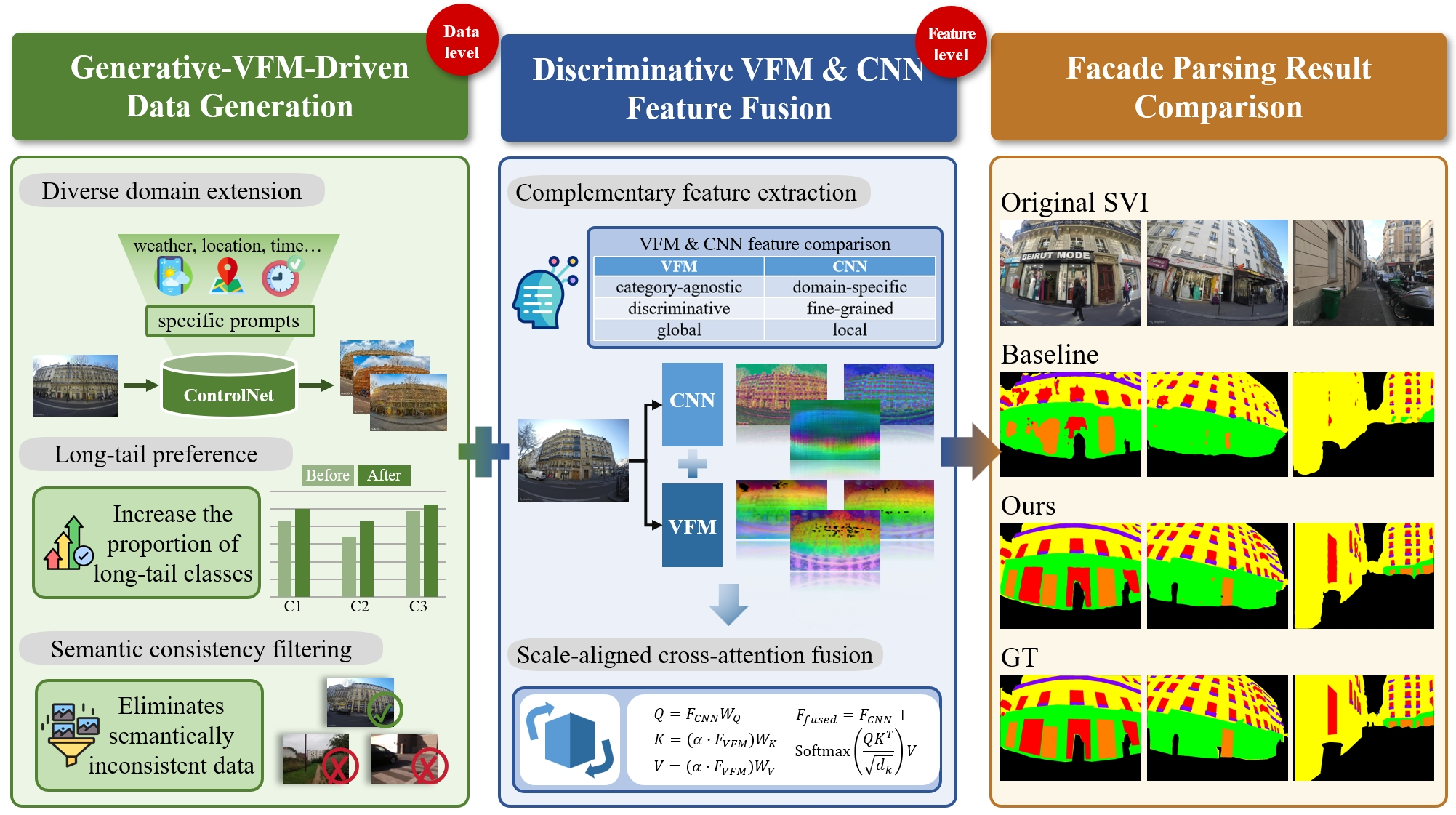
We introduce VFM-FP, a visual foundation model-guided framework for robust facade parsing from street-view images. It improves generalization and long-tail recognition through diffusion-generated data, while fusing global visual priors with local features to better capture complex facade structures.
Simulated Point Clouds Explicitly Guided Semantic Segmentation
Zhe Chen, Jiahao Zhou, Chen Long, Peiling Tong, Panyin Li, Fuxun Liang*, Zhen Dong
Photogrammetric Engineering & Remote Sensing (IF: 3.0) 2026
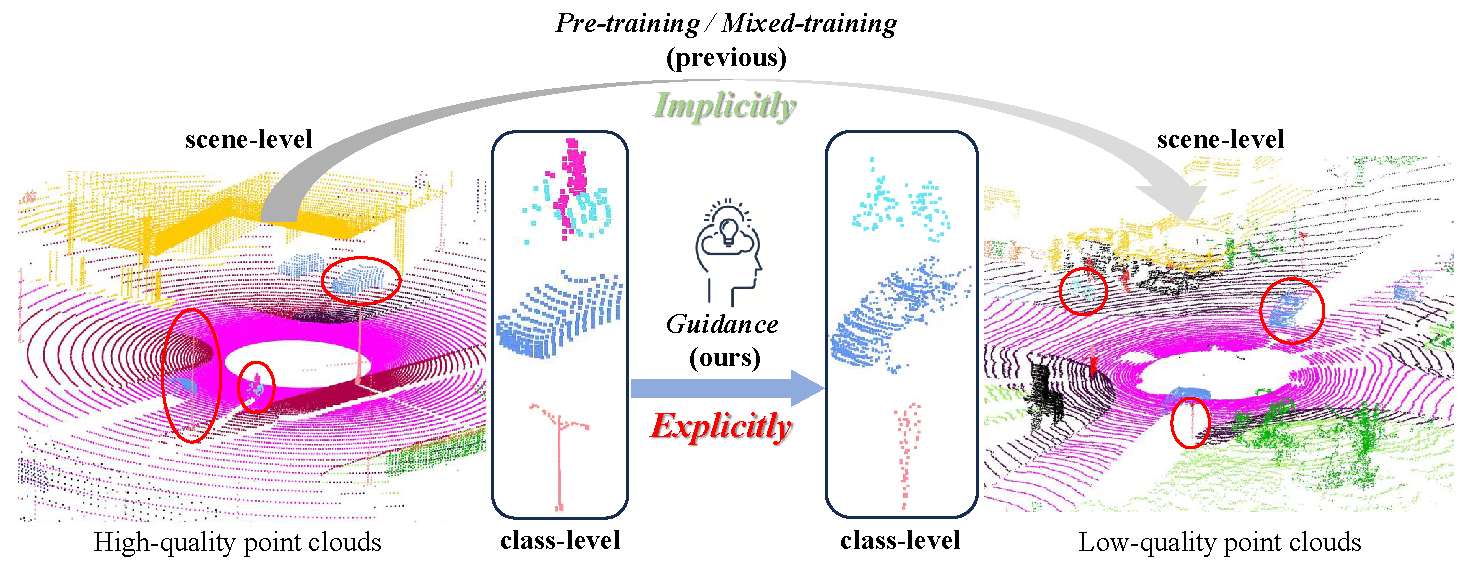
We introduce SimPCSS, a plug-and-play supervised learning scheme that leverages high-quality simulated point clouds to improve semantic segmentation of sparse and noisy real-world point clouds. Specifically, SimPCSS extracts multi-scale, high-confidence features from labeled simulated data as prior guidance and transfers this knowledge to low-quality point clouds through imitation learning. The method is model-agnostic and consistently improves MinkUNet and PTv3 on both synthetic and real-world datasets.
WHU-STree: A multi-modal benchmark dataset for street tree inventory
Ruifei Ding†, Zhe Chen†, Wen Fan, Chen Long, Huijuan Xiao, Yelu Zeng, Zhen Dong*, Bisheng Yang
ISPRS Journal of Photogrammetry and Remote Sensing (IF: 12.2) 2026
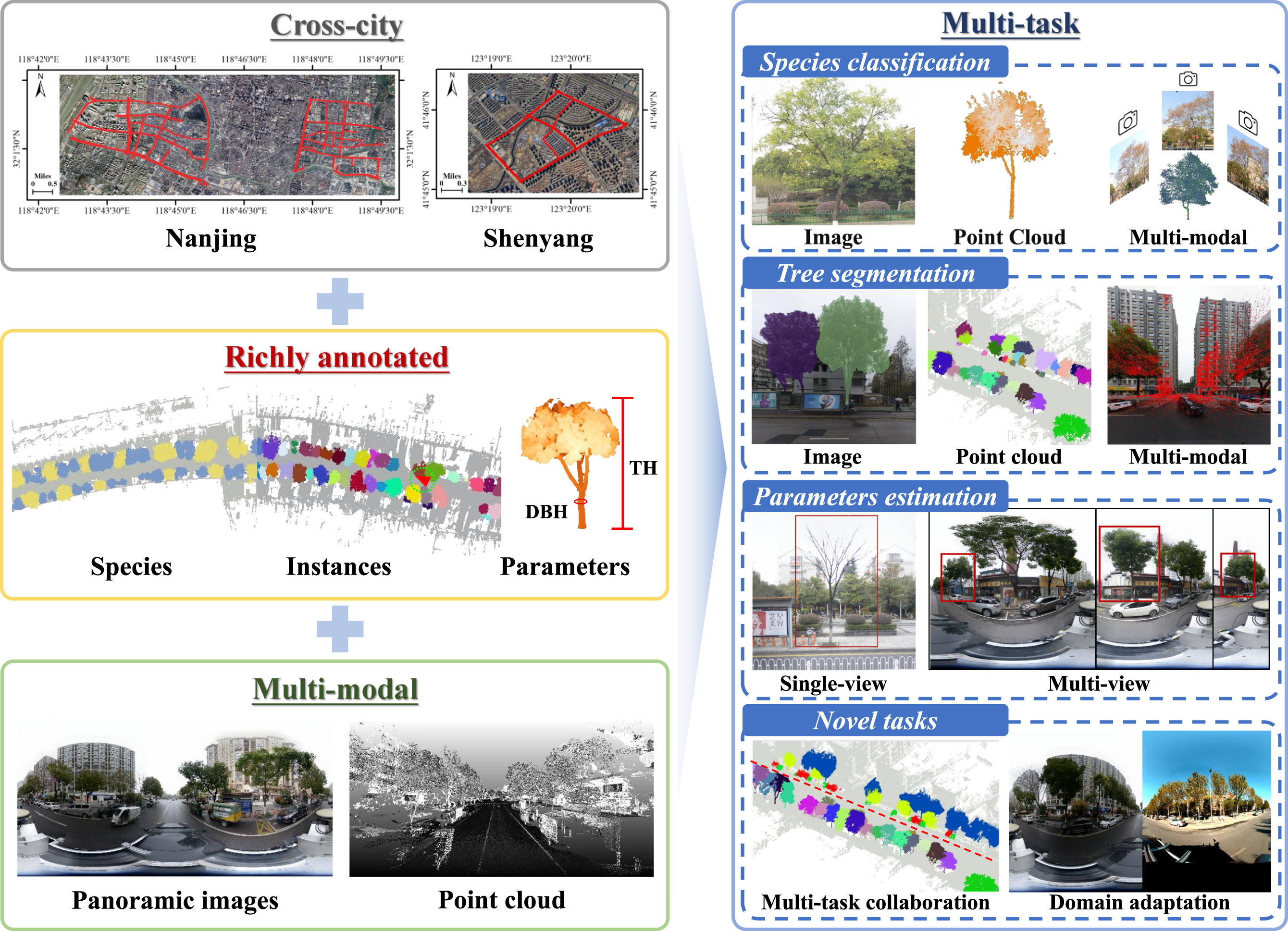
We introduce WHU-STree, a cross-city, richly annotated, and multi-modal urban street tree dataset designed for comprehensive inventory analysis, from initial individual tree segmentation, through species classification, to macro-level asset management. Besides, we implement several novel settings, making it possible to realize certain ideas that are difficult to achieve in traditional MMS datasets, such as concurrently supporting over 10 inventory tasks, integrating synchronized point clouds with high-resolution images, and benchmarking cross-domain multi-modal fusion challenges.
TSC-Net: a roadside tree structure parameter computation network using street-view images
Chen Long, Dian Chen, Zhe Chen, Ruifei Ding, Zhen Dong*, Bisheng Yang
Geo-spatial Information Science (IF: 5.5) 2026
We propose TSC-Net, an efficient end-to-end network that accurately estimates tree height and diameter from low-cost street-view images by integrating semantic and geometric cues through a decoupled dual-branch encoder and auxiliary regression tasks, significantly outperforming existing methods in both accuracy and speed.
2025
LifelongPR: Lifelong Point Cloud Place Recognition Based on Sample Replay and Prompt Learning
Xianghong Zou, Jianping Li*, Zhe Chen, Zhen Cao, Zhen Dong, Qiegen Liu*, Bisheng Yang
IEEE Transactions on Intelligent Transportation Systems (IF: 9.1) 2026
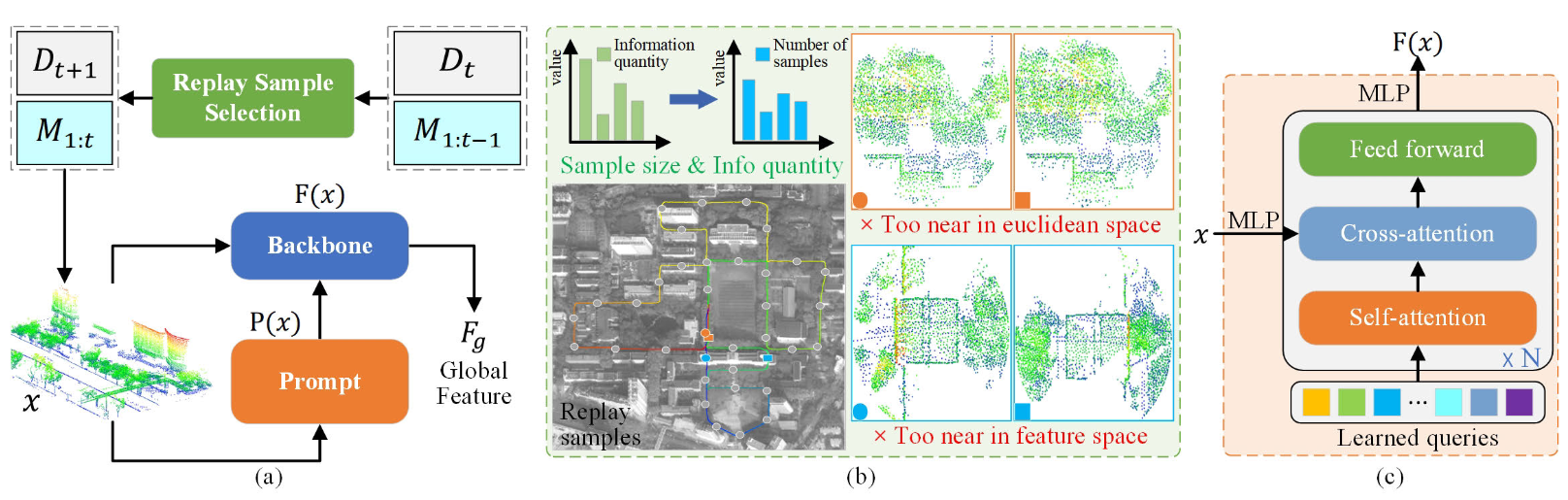
We introduce LifelongPR, a continual learning framework for point cloud place recognition that mitigates catastrophic forgetting across changing environments and sensors. It combines representative replay sample selection with lightweight prompt learning to retain prior knowledge while adapting to new domains.
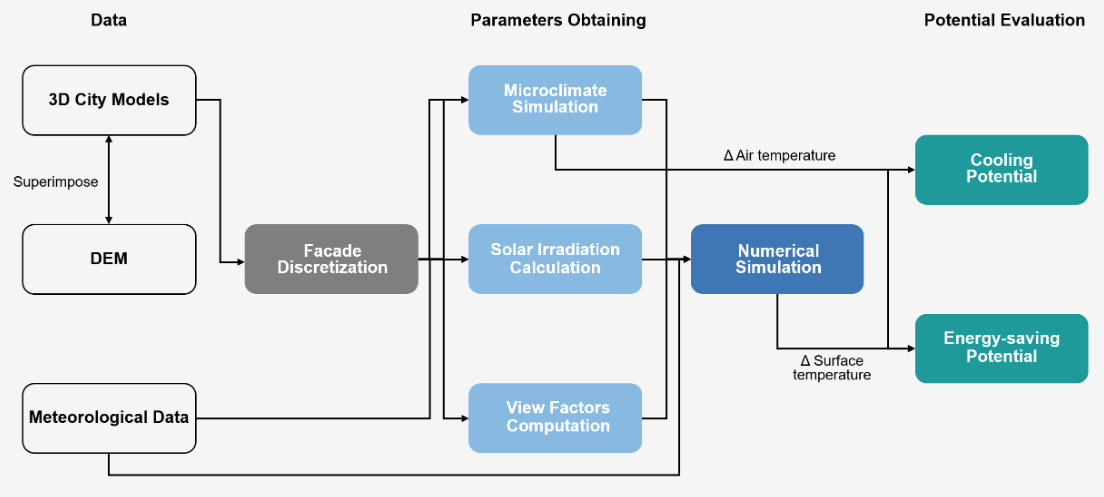
Evaluating cooling and energy-saving potential of Vertical Greenery Systems based on 3D City Models: A case study of three cities
Chengjie Li, Zhe Chen, Fuxun Liang, Zhen Dong, Bisheng Yang*
The International Archives of the Photogrammetry Remote Sensing and Spatial Information Sciences 2025
Vertical Greenery Systems (VGS) offer a promising solution to urban heat and energy demands, yet their evaluation using precise 3D city models remains limited. To address this, we developed a novel 3D simulation workflow—integrating microclimate, solar irradiation, and view factor computations—to assess the cooling and energy-saving potential of VGS in Wuhan, Hong Kong, and Singapore. Our results demonstrate that VGS performance is highly dependent on local climate and urban morphology, establishing a strong foundation for future city-scale optimizations.
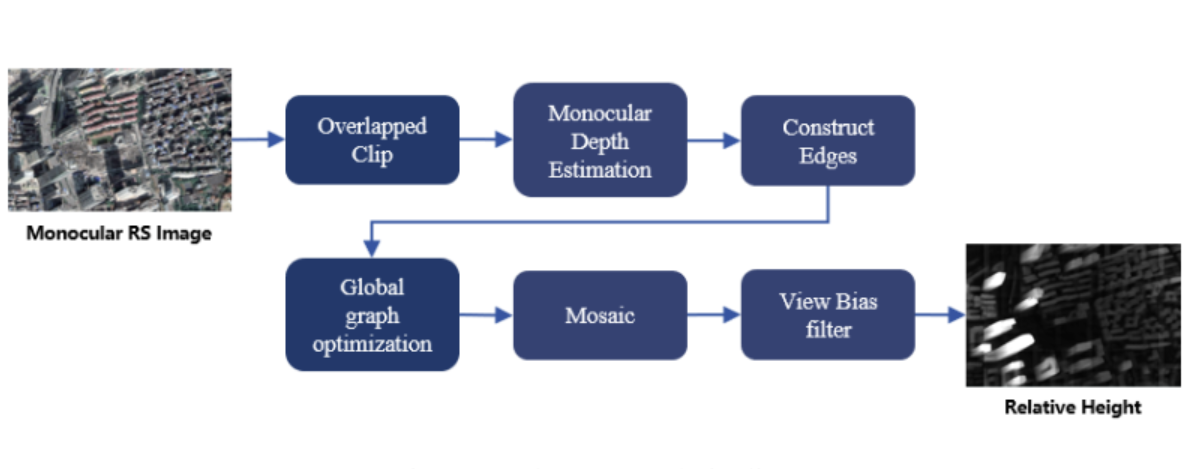
A training-free method for estimating the relative height of buildings
Zhe Chen, Chengjie Li, Fuxun Liang, Tong Peiling, Chen Long, Zhen Dong, Bisheng Yang*
The International Archives of the Photogrammetry Remote Sensing and Spatial Information Sciences 2025
We propose a training-free approach based on a vision foundation model that achieves highly accurate, annotation-free estimation of individual building heights by extracting and structurally optimizing relative depth from high-resolution remote sensing imagery, significantly outperforming existing baselines.
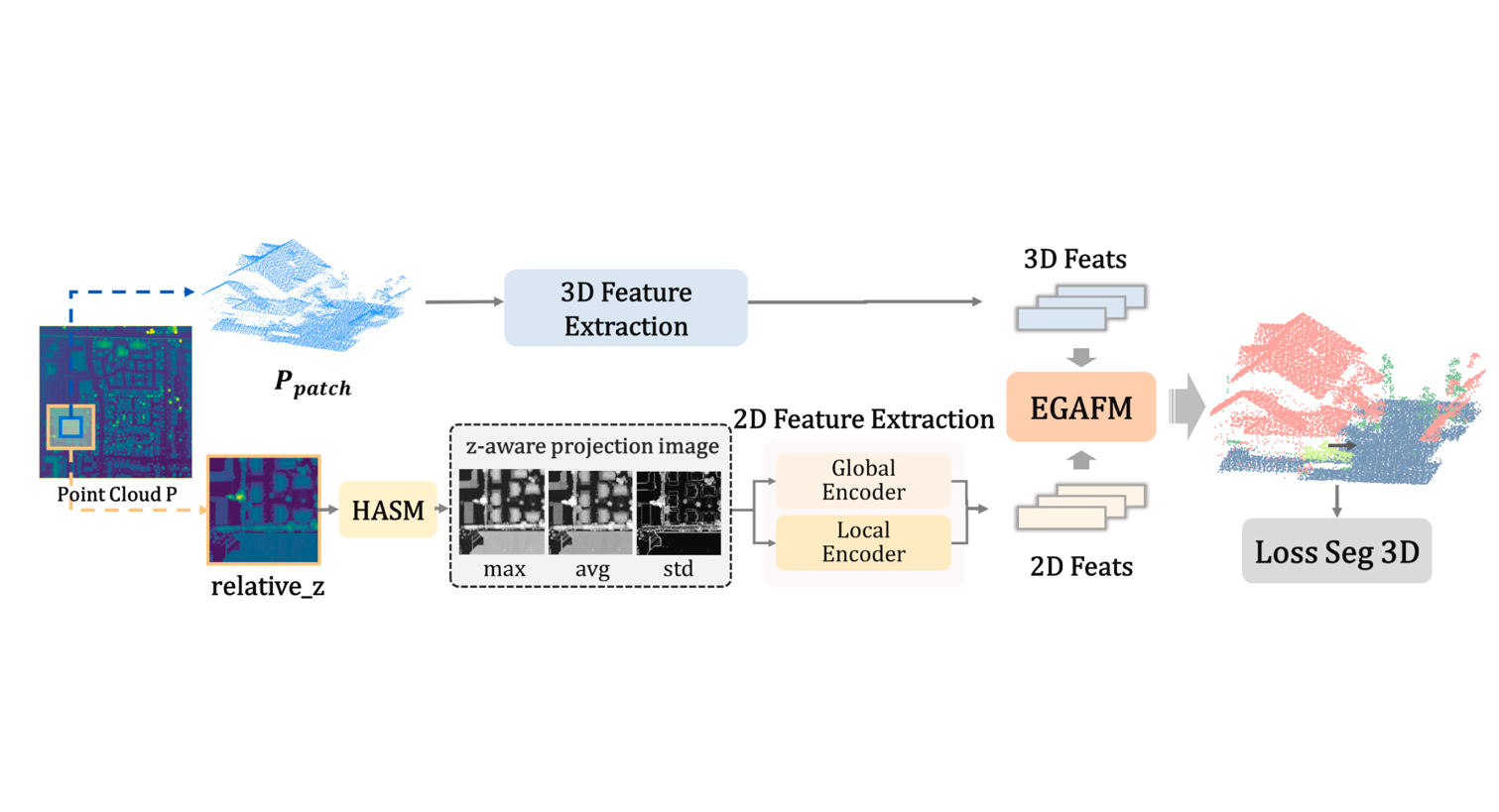
A novel projection map driven multimodal fusion framework for ALS point cloud semantic segmentation
Pangyin Li†, Zhe Chen†, Chen Long, Huazu Zhang, Yang Lv, Ronggang Huang, Zhen Dong, Bisheng Yang*
International Journal of Applied Earth Observation and Geoinformation (IF: 8.6) 2025
We introduce EGAFNet, a novel multimodal framework designed for ALS point cloud semantic segmentation, from the initial elevation-guided input representation, through dual-branch feature extraction, to adaptive 2D-3D feature fusion. Besides, we implement several novel settings, making it possible to realize certain ideas that are difficult to achieve in traditional multi-sensor fusion methods, such as utilizing single-source ALS data for multimodal perception, adaptively scaling object heights in 2D projections, and mitigating feature confusion caused by elevation occlusion.
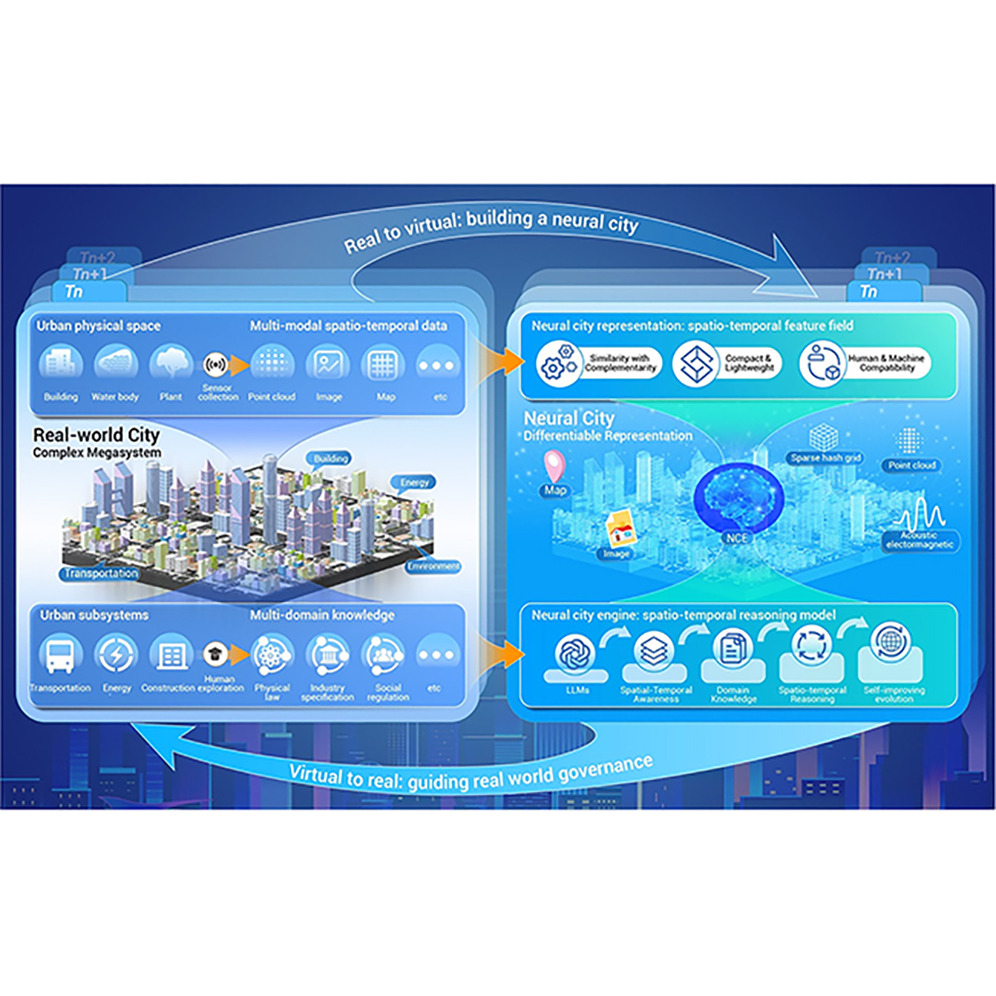
The Neural City: A next-generation spatio-temporal intelligence paradigm for urban holistic governance
Zhen Dong†, Haiping Wang†, Zhe Chen, Chen Long, Yuning Peng, Yuan Liu, Fuxun Liang, Jian Zhou, Yiping Chen, Fan Zhang, Bisheng Yang*, Deren Li
The Innovation (IF: 25.7) 2025
We outline Neural City to enable end-to-end urban governance, seamlessly linking raw urban data to holistic urban governance, achieving "6W+4R" governance.
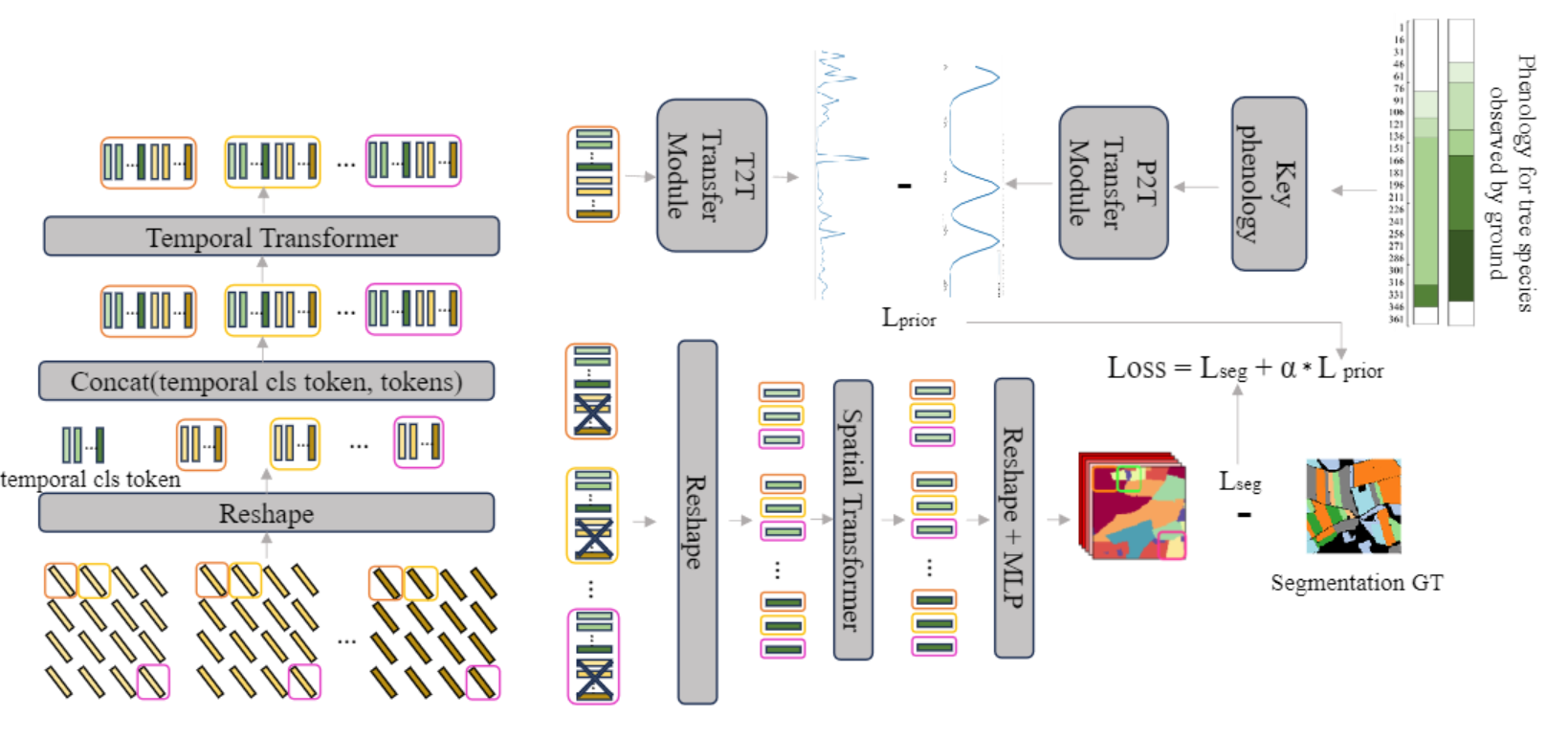
Integrating Phenological Priors with Deep Spatio-Temporal Features for tree species mapping
Zhanyu Ma, Ningning Zhu, Zhen Dong, Ruibo Chen, Bisheng Yang*, Zhe Chen, Chen Long, Ruifei Ding
ISPRS Annals of the Photogrammetry Remote Sensing and Spatial Information Sciences 2025
We introduce PTSViT, a deep learning framework for automated tree species mapping that bridges spatio-temporal feature extraction, phenological knowledge integration, and macro-level forest carbon estimation. Furthermore, we implement novel settings to overcome traditional Earth observation limitations, such as embedding geoscientific priors directly into the loss function, utilizing ground-based phenology as supervisory signals, and adapting to regional variations in species behavior.
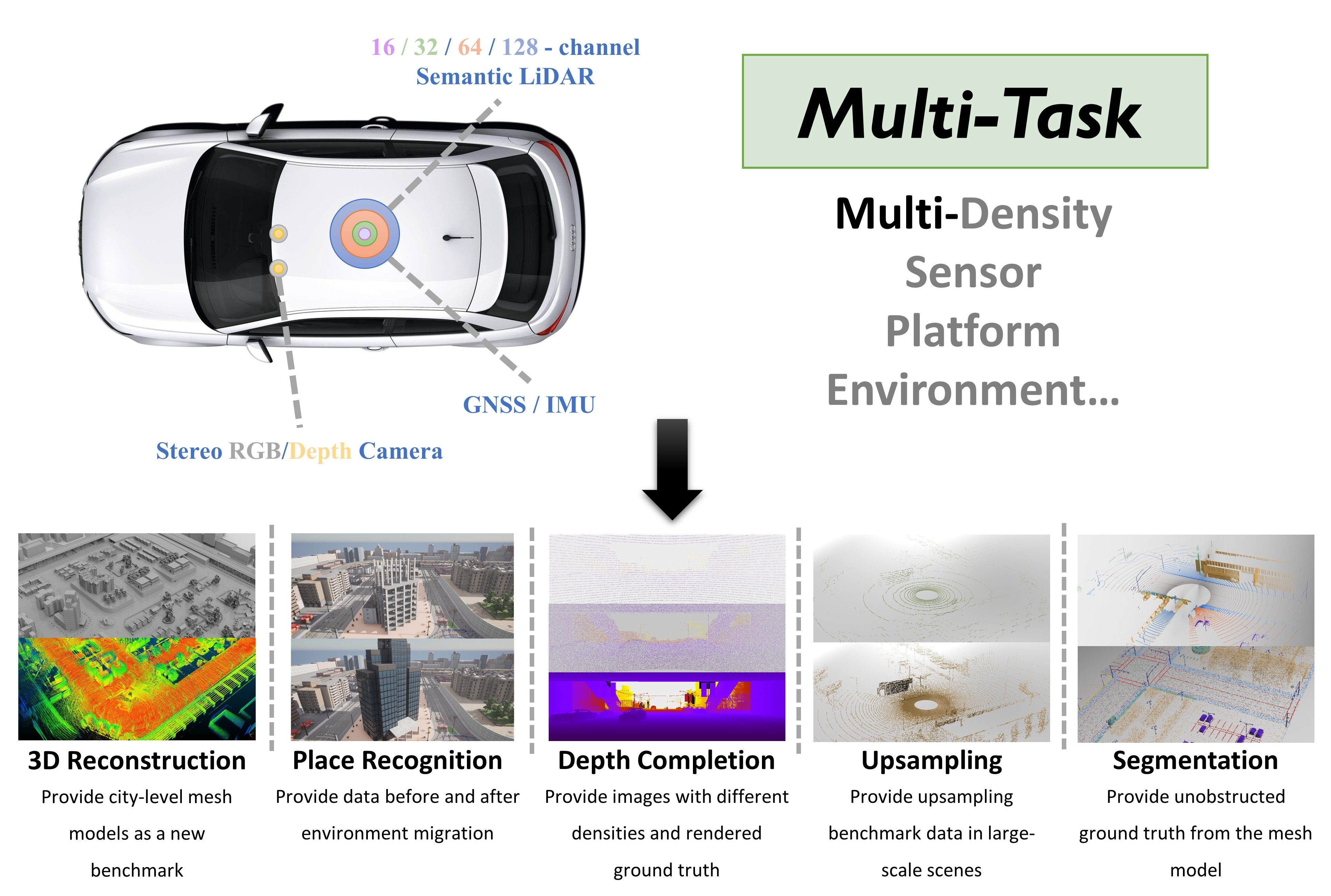
WHU-Synthetic: A Synthetic Perception Dataset for 3D Multi-task Model Research
Jiahao Zhou†, Chen Long†, Yue Xie, Jialiang Wang, Conglang Zhang, Boheng Li, Haiping Wang, Zhe Chen*, Zhen Dong
Transactions on Geoscience and Remote Sensing (IF: 8.6) 2025
We introduce WHU-Synthetic, a large-scale 3D synthetic perception dataset designed for multi-task learning, from the initial data augmentation, through scene understanding , to macro-level tasks. Besides, we implement several novel settings, making it possible to realize certain ideas that are difficult to achieve in real-world scenarios, such as sampling on city-level models, providing point clouds with different densities, and simulating temporal changes.
2024
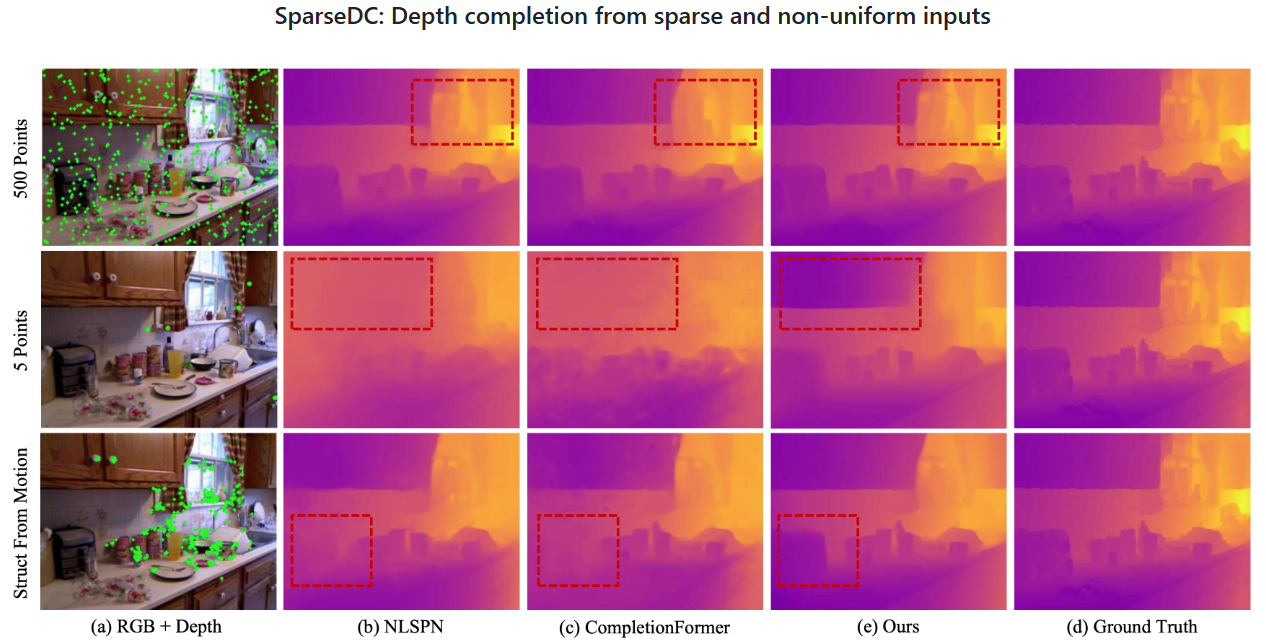
SparseDC: Depth Completion From Sparse and Non-uniform Inputs
Chen Long*, Wenxiao Zhang*, Zhe Chen, Haiping Wang, Yuan Liu, Zhen Cao, Zhen Dong†, Bisheng Yang
Information Fusion (IF: 14.8) 2024
SparseDC is a model for Depth Completion from Sparse and non-uniform inputs. Numerous experiments conducted both indoors and outdoors show how robust and effective the framework is when facing sparse and non-uniform input depths.
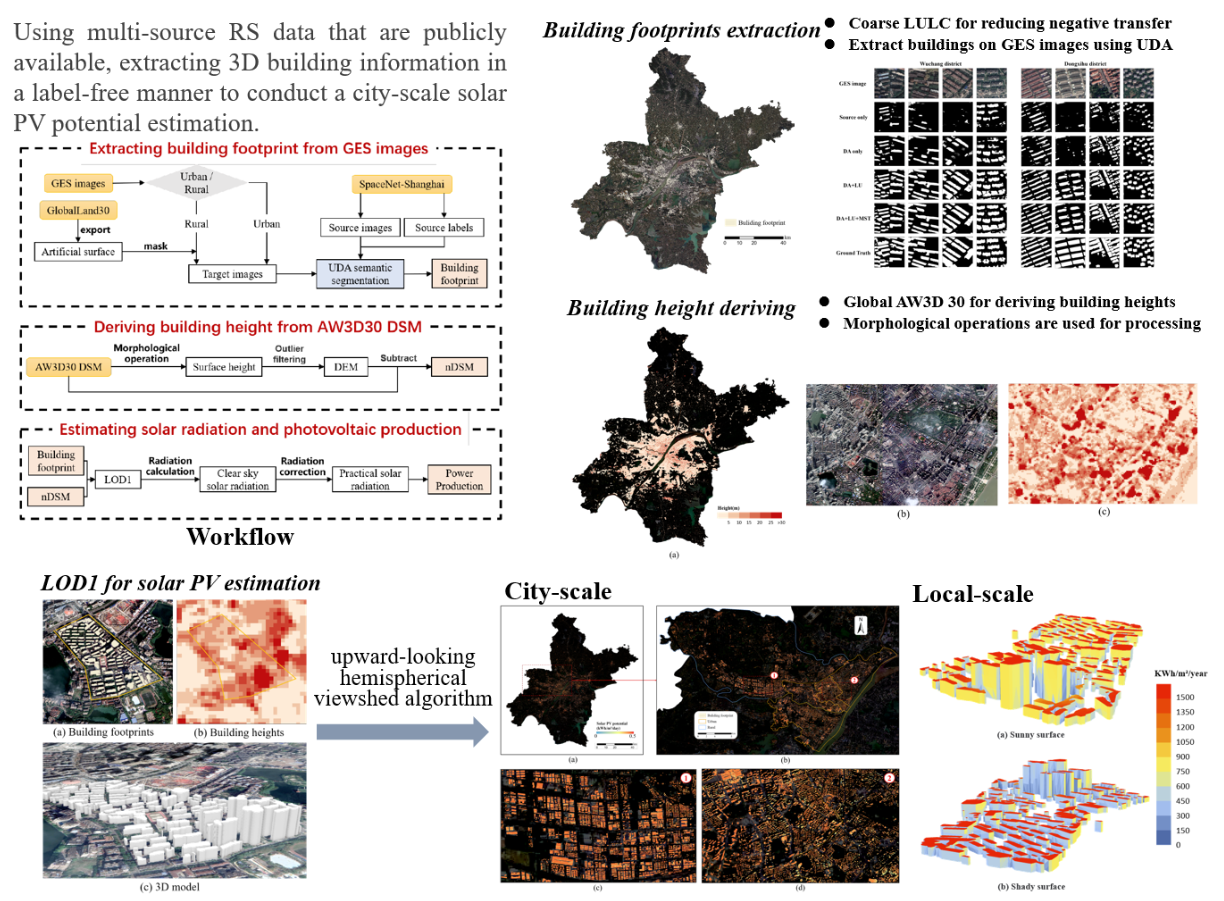
City-scale solar PV potential estimation on 3D buildings using multi-source RS data: A case study in Wuhan, China
Zhe Chen, Bisheng Yang†, Rui Zhu, Zhen Dong
Applied Energy (IF: 10.1) 2024
This study proposes a framework for estimating the solar PV potential of city-level building surfaces without human annotation and data acquisition costs. Buildings are extracted from Google satellite images through multi-space joint optimization domain adaptation network, and LoD1 models are generated by combining global DSM with building footprints. The framework was verified by taking Wuhan city as an example.
2022
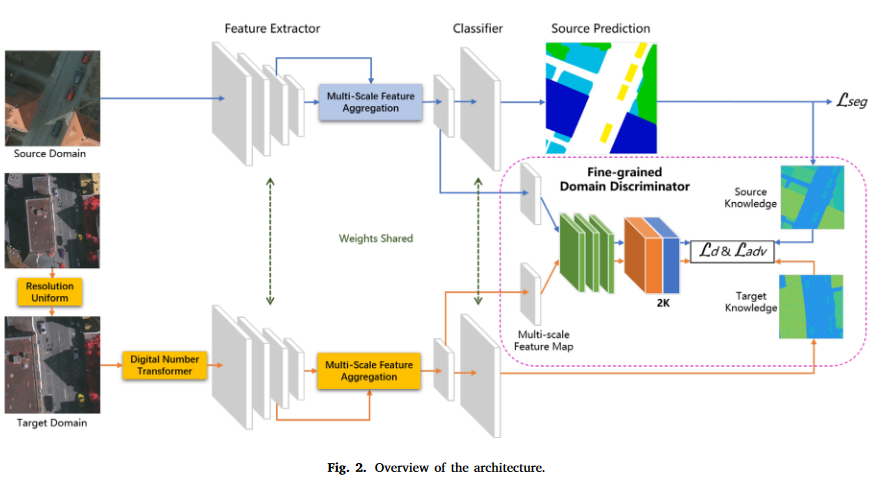
Joint alignment of the distribution in input and feature space for cross-domain aerial image semantic segmentation
Zhe Chen, Bisheng Yang, Ailong Ma, Mingjun Peng, Haiting Li, Tao Chen, Chi Chen†, Zhen Dong
International Journal of Applied Earth Observation and Geoinformation (IF: 7.6) 2022
A framework to jointly align the distribution in input and feature space for cross-domain aerial image semantic segmentation, our method demonstrates excellent performance in various cross-domain scenarios, including the discrepancy in geographic position and the discrepancy in both geographic position and imaging mode.